One man’s road from Westminster to the machine that carries Iran’s story abroad

Arash Sohrabi
Arash SohrabiIran International

An Iran International investigation has uncovered financial records and professional ties that shed light on how Tehran’s influence operations extend beyond its state broadcasters into ostensibly independent media outlets around the world.

Drawing on internal correspondence, corporate records and published material, the investigation traces the movement of money, journalists and Tehran’s narratives through overlapping media networks in Britain, Africa and beyond.

At the centre is Ahmed Kaballo, a former British parliamentary assistant who worked for Iran’s Press TV before founding African Stream, an outlet Washington later accused of being secretly run by Russia’s RT.

Kaballo now heads the collective Sovereign Media, which republishes Iranian state media content and features several Press TV contributors.

The documents reveal how Press TV financed its London operation through British companies and alternative payment arrangements, including cash delivered through the Iranian embassy.

They also trace Kaballo’s financial ties to the broadcaster, his subsequent recognition at a Tehran media festival and the funding of his latest venture by a collective associated with an American heir detained in Spain over alleged terrorism-related offences.

None of the documents reviewed by Iran International establishes that Sovereign receives money or editorial instructions from Tehran. But together, they reveal a web of financial, professional and editorial relationships linking Iran’s state broadcasting apparatus to media organisations presenting themselves as independent.

The London connection

Kaballo’s career in political media began in the office of George Galloway, the former British MP and longtime presenter for Press TV.

Between 2013 and 2016, Kaballo worked as Galloway’s parliamentary assistant and research manager for his Respect party. He also produced television programmes involving Galloway and former London mayor Ken Livingstone, another Press TV presenter.

In 2016, Kaballo joined Press TV’s London operation, four years after Britain’s broadcasting regulator Ofcom had revoked the channel’s licence over editorial control exercised from Tehran.

The loss of its licence did not end Press TV’s activities in Britain. The broadcaster maintained staff, production operations and financial arrangements through British companies.

Internal correspondence obtained by Iran International reveals how those arrangements worked.

On June 29, 2020, Alireza Norouzi, a financial manager at Press TV’s Tehran headquarters, wrote to Mehdi Mirtaleb, head of its London office, questioning nine months of reporting fees paid to Kaballo.

The payments, totalling £41,719.06, had been made by Aparat Ltd, a London production company associated with Mirtaleb, for work between February 2019 and January 2020.
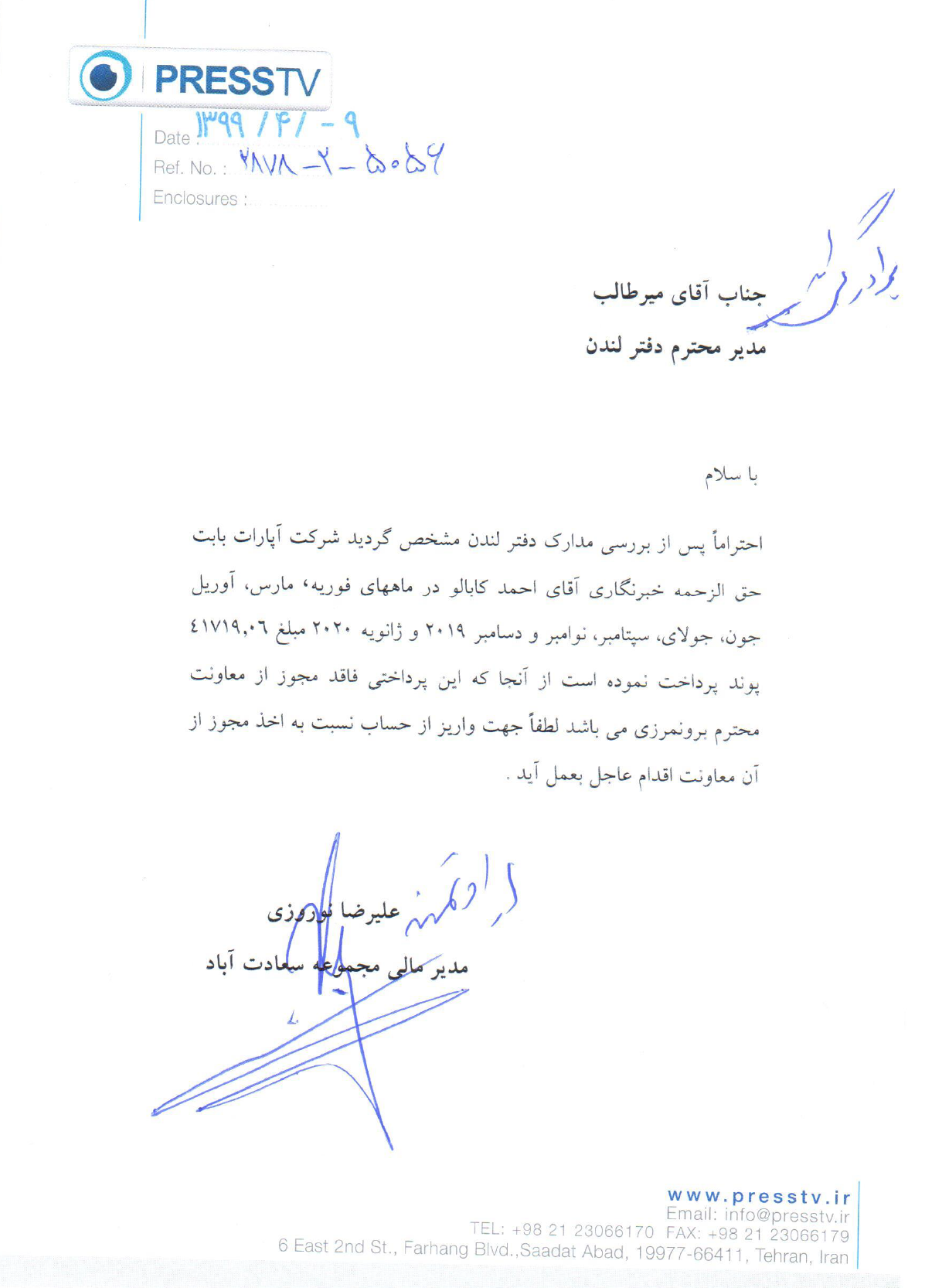
A June 2020 letter from Press TV’s finance office in Tehran to its London chief, querying £41,719 in fees paid to Ahmed Kaballo through Aparat Ltd.

Norouzi said the payments had not received the necessary approval from the state broadcaster’s World Service and asked London to obtain authorisation so Press TV could reimburse Aparat.

Aparat, incorporated in 2009, is directed by Mariola Mirtaleb, who shared an address with Mehdi Mirtaleb that year. He identifies himself as its co-founder. Kaballo used an Aparat email address in Press TV correspondence.

The records establish that a British company paid Kaballo for work subject to financial oversight by the Iranian state broadcaster’s headquarters.

In February 2019, Mirtaleb wrote to Peyman Jebelli, then head of the broadcaster’s World Service, explaining that sanctions-related banking restrictions had made transferring money to London increasingly difficult.

Eight bank accounts had been closed, he said, while exchange houses in Britain, Germany and Spain refused to handle transactions because of the operation’s links to Iran.
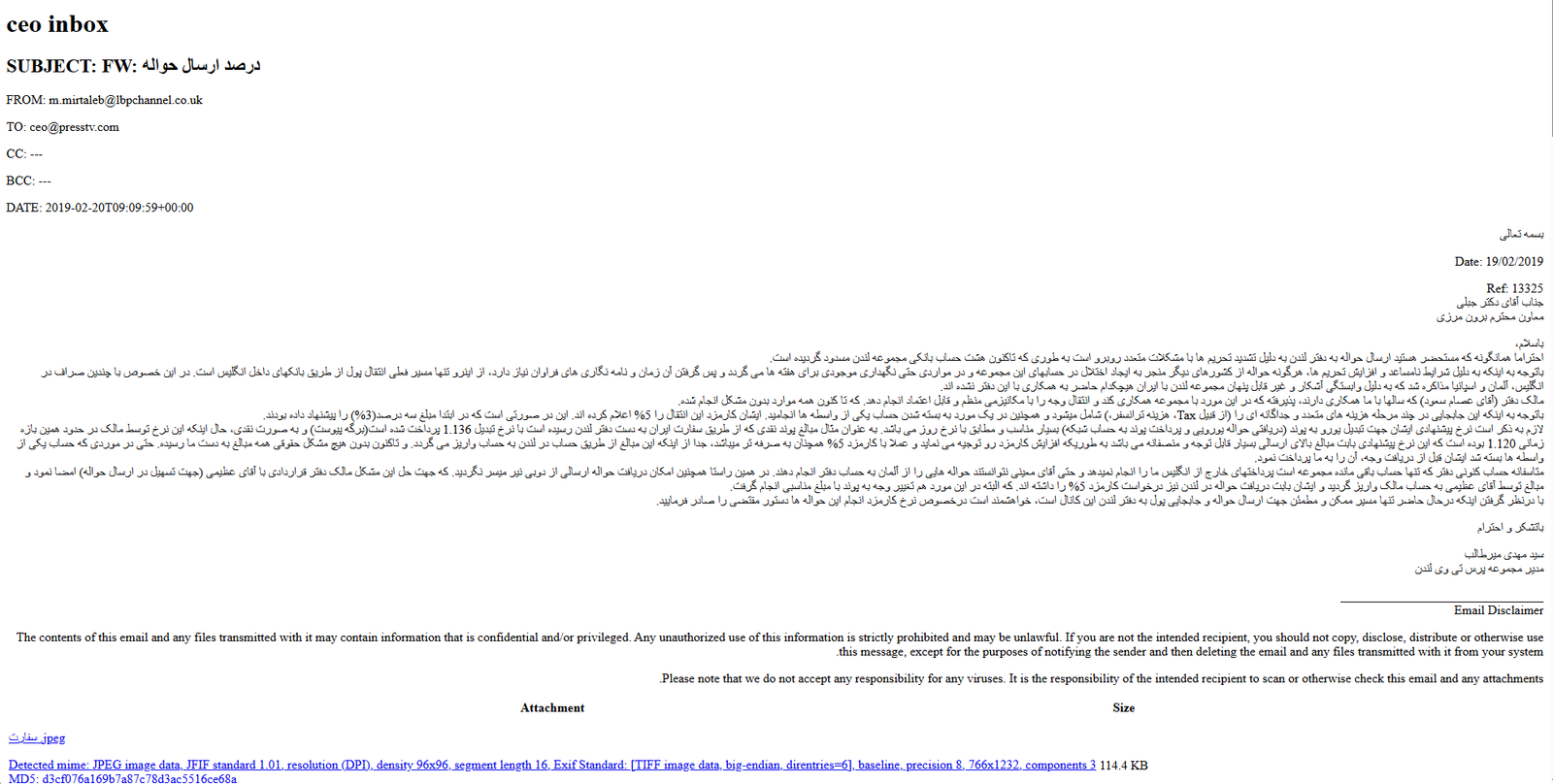
A February 2019 letter from Press TV’s London chief to the head of IRIB’s World Service, describing cash received through the Iranian embassy and a landlord’s company used to move money after eight bank accounts were closed.

Mirtaleb described an alternative arrangement involving the owner of the London premises, who received Press TV funds abroad and transferred equivalent sums into the operation’s British account through his own company.

Mirtaleb also reported receiving cash in pounds through the Iranian embassy, describing the arrangements as the only secure means then available.

In another letter, written two years later, he thanked Jebelli for the regular transfer of a £120,000 monthly budget and requested additional funding for expenses including equipment purchased in Russia, technical work and outstanding production costs.
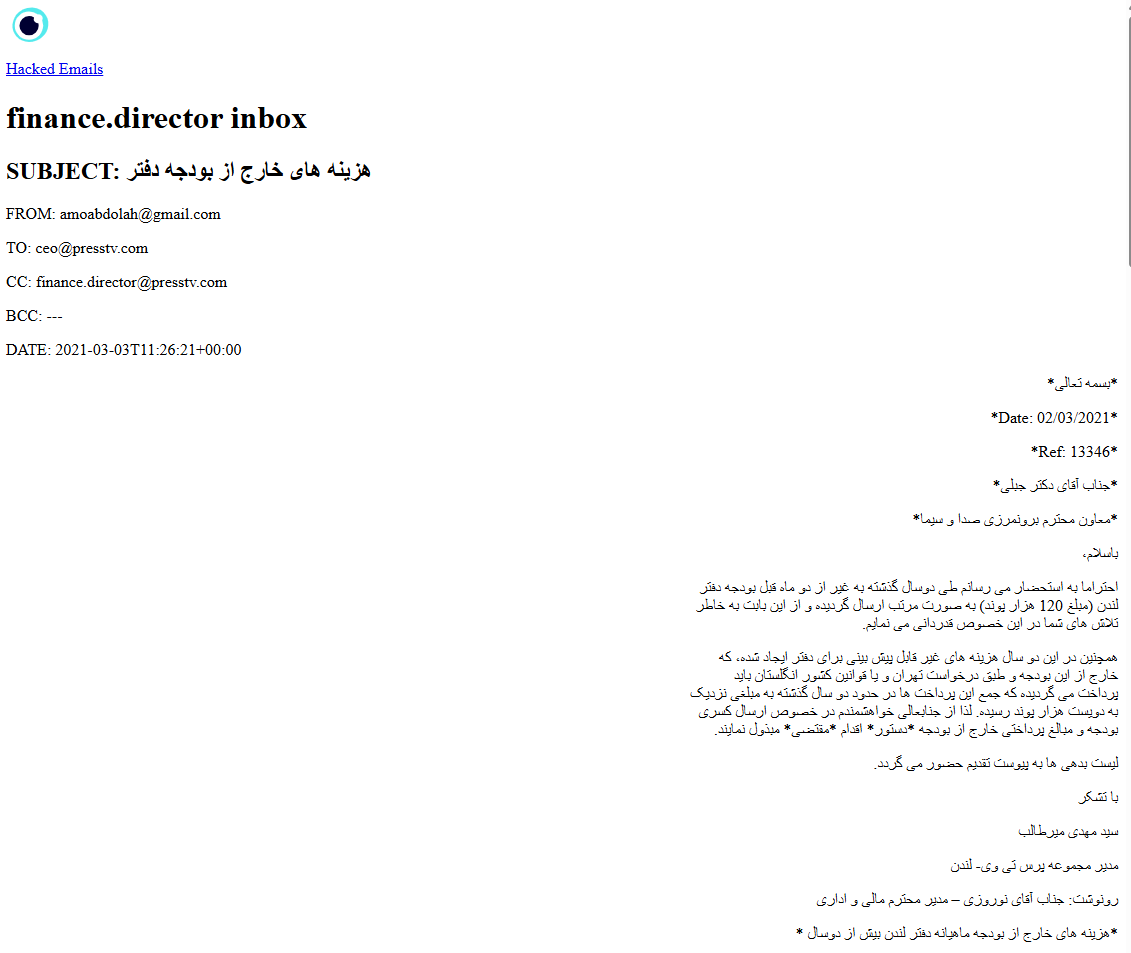
A March 2021 letter from Press TV’s London chief thanking Tehran for the regular arrival of the office’s monthly budget and asking for more, including for equipment bought in Russia.

The correspondence provides a rare account of how Iran’s foreign broadcasting operation maintained its presence in London despite the loss of its broadcasting licence and restrictions on financial transfers.

Jebelli, now head of Iran’s state broadcaster, was sanctioned by the United States in 2022. Ahmad Noroozi, who subsequently led the World Service, has also been sanctioned by Western governments.

Neither Mirtaleb nor Press TV is under British sanctions. Mirtaleb has previously dismissed allegations surrounding his companies as conspiracy-driven.
From Press TV to African Stream

In March 2022, four days after Ofcom revoked Russia’s RT broadcasting licence, Scottish writer John Wight emailed Mirtaleb with a proposal for a Press TV programme.

“I received your email address from Ahmed Kaballo and at his recommendation have attached a proposal for a new show for Press TV,” Wight wrote.

Wight, a former contributor to RT and Sputnik, subsequently forwarded the proposal to Ahmad Noroozi, by then head of Press TV’s World Service. There is no evidence the programme was produced.

Asked about the exchange, Wight told Iran International he had “no recollection of Ahmed Kaballo ever introducing me to Press TV’s London office for any such proposal,” and that no programme was commissioned and he had received no payment from Press TV for any work since 2022.

John Wight’s March 2022 email to Press TV’s London office, sent four days after Ofcom revoked RT’s British license, pitching a show “at the recommendation” of Ahmed Kaballo.

The correspondence shows Kaballo facilitating a professional introduction to Press TV in the year he says he left the broadcaster. That same year, he launched African Stream, a social-media news outlet targeting African audiences.

In September 2024, the US State Department accused African Stream of being secretly operated by RT. YouTube, Meta and TikTok subsequently removed its accounts. Kaballo denied the allegation.

“Yes, I, Ahmed Kaballo, the CEO, used to work for Press TV, an Iranian-funded channel, but I don’t work for them anymore, and they have absolutely nothing to do with African Stream,” he wrote in 2023.

Press TV released a documentary on Nicaragua featuring Kaballo in July 2023, although it is unclear when the film was commissioned or whether he remained employed by the broadcaster.

In May 2024, Kaballo travelled to Tehran to attend the Sobh International Media Festival, organised by the Iranian state broadcaster’s World Service. He received the festival secretary’s special award for his work with African Stream.

The festival’s senior figures included Jebelli and Ahmad Noroozi, both closely associated with the broadcasting operation in which Kaballo had previously worked. His name subsequently appeared on the festival’s team page in May 2025.

Ahmed Kaballo on the “team” page of the Sobh International Media Festival, an event run by the Iranian state broadcaster’s World Service, added in May 2025.

A new media collective

That same month, Kaballo registered Sovereignty Media Group in Britain, with himself as sole director and person with significant control.

Its founding documents described an ambition to build “the largest global coalition of anti-imperialist media.”

On June 20, 2025, four days after an Israeli strike on the Iranian state broadcaster’s headquarters in Tehran, a statement signed by the Sovereign Media collective appeared on the Progressive International website condemning the attack as an assault on journalism.

African Stream was among the signatories. Two days later, African Stream announced its closure.

Sovereign subsequently launched as a media collective describing itself as based in Nairobi, with contributors and partners spanning Africa, Latin America, the Middle East and the United States.

Its website offers partners training, social-media expertise and “strategic messaging kits,” describing its project as an “infrastructure of resistance.”

Its partners include Venezuelanalysis, Orinoco Tribune, Bolivia’s Kawsachun News, Black Agenda Report and Vox Ummah.

The collective’s connection to Iranian state broadcasting is visible in its contributors and published material.

At least five individuals who have worked for Press TV or its Spanish-language sister channel have also appeared under Sovereign’s name.

Shabbir Rizvi, a Chicago-based “activist” who frequently appears on Iran’s state-run Press TV as a pundit, is seen in a video shared by @TheFP teaching a group of so-called “anti-war activists” how to chant “Death to Israel” and “Death to America” slogans in Persian. https://t.co/fWhdoYogox

— Iran International English (@IranIntl_En) April 16, 2024

Among them is Shabbir Rizvi, a Chicago-based activist and political director of Vox Ummah who writes for Press TV. In July 2026, Press TV identified him to readers as a Sovereign journalist.

Camila Escalante, a co-founder of Kawsachun News, has reported for Press TV since 2021. Alejandro Kirk, a correspondent for the broadcaster’s Spanish-language service, contributed articles to Sovereign in late 2025. Naqaa Hamed has reported for both outlets.

On January 19, 2026, during the crackdown on nationwide protests in Iran, Sovereign republished a Press TV article by Rizvi that portrayed the unrest as foreign-backed violence.

Headlined “Bogus claims, fake sources: Who ignited the flames of unrest and sedition in Iran,” the article described protesters as participants in “foreign-backed deadly riots” and suggested that civilians had been killed by armed rioters.

It also attacked Iran International’s reporting, describing the outlet as linked to Israeli intelligence and accusing it of fabricating accounts from Iran.

Sovereign published the article with Press TV’s original disclaimer attached.

In September, Sovereign’s own Instagram account alleged, without presenting evidence, that the CIA and Mossad had coordinated attacks on Iranian civilian facilities.

Its contributor guidelines prohibit “imperialist regime-change narratives” and restrict reliance on Western state-affiliated sources. They contain no equivalent restriction on Iranian state media.

The American funder

On February 24, 2026, Sovereign disclosed on X that it received funding from Babochki Collective, without specifying the amount, duration or conditions.

Babochki was established with the involvement of James “Fergie” Chambers, an heir to the American Cox media fortune who describes himself as a Marxist-Leninist.

Chambers has funded left-wing and pro-Palestinian political causes and helped establish Palestine Action US following the Hamas-led October 7, 2023 attack on Israel. He has publicly defended Hamas and described the attack as a source of inspiration.

In July 2026, Chambers was detained in Spain and has since been fighting extradition to the United States.

Although the American indictment remains sealed, Spanish court records described in reporting by El Español and the Free Press outline allegations that Chambers transferred more than $7 million from the United States to Tunisia.

According to those reports, some transfers coincided with visits to the Iranian embassy in Tunis. Prosecutors also cited statements from associates concerning his contacts with Iranian officials and alleged ambitions to participate in terrorist activities.

Chambers’ wife, Stella Schnabel, and his lawyer, Baltasar Garzón, deny that he financed Hamas or terrorism. They maintain that his political and charitable activities were lawful and that he is being targeted for supporting Palestinians.

A Spanish judge refused him bail in October.

Sovereign has defended Chambers against the allegations, describing him as a philanthropist facing political persecution. The outlet’s public statements defending him did not disclose its previously acknowledged financial relationship with Babochki.

The investigation does not establish that funds associated with Iran reached Sovereign, or that Chambers’ alleged dealings with Iranian officials were connected to his support for the collective.

Nor do the documents establish that Sovereign receives Iranian funding or takes editorial instructions from Tehran. What they reveal instead is a network of overlapping financial arrangements, professional relationships and shared content linking Iran’s state broadcaster to media organisations presenting themselves as independent.

The findings illustrate how Tehran’s narratives can reach international audiences without a documented chain of command, travelling through journalists and media platforms that give them new audiences and an appearance of independence.

More stories

  • Inside the IRGC-linked corporate network controlling Iran’s internet

    Iran’s Revolutionary Guards retain extensive connections to the companies running the country’s telecommunications networks, an Iran International investigation has found, exposing a wider system of military-linked businesses, state foundations and technology contractors that enables authorities to control internet access.

    Iran International

  • A Mossad spy in Iran: From banking and telecoms infiltration to nuclear sabotage and the Malard missile center blast

    Iran International

  • 670 bridges, 380 tunnels: The network that moves Iran's army and its missiles

    Four small bridges, struck in one night in April, cut Tehran off from Iran's entire railway. All were fixed within days. The bridges that would take years to rebuild are still standing, on lines that carry Iran's missiles, its troops and its trade.

    Iran International

  • The body as a battleground: Iran's resistance etched in ink and blood

    Iran International

Iran International

One man’s road from Westminster to the machine that carries Iran’s story abroad

An Iran International investigation has uncovered financial records and professional ties that shed light on how Tehran’s influence operations extend beyond its state broadcasters into ostensibly independent media outlets around the world.

Published: 5 November 2026

Volant Media

All rights to this site belong to Volant Media.

© 2026 Volant Media